
Malindi Elmore · Part 3 of 3
Malindi Elmore is a 3x Olympian and Canada’s most successful female marathoner, and a mother of two boys aged 8 and 12. In Parts 1 and 2, she shared what training and competing look like with older kids. In this final part, she talks about injury, longevity, and what Team Canada could do differently.
Miss part one? Read it here.
Longevity, Recovery, and Value-Based Sponsorships
You ran 2:24 in December 2025 at nearly 46. What has the year since been like?
My training had gone so well last fall, and I knew I was ready to have a really great race. I was in the best shape I’d been in going into a marathon. I was still very happy with the result and how I executed the race.
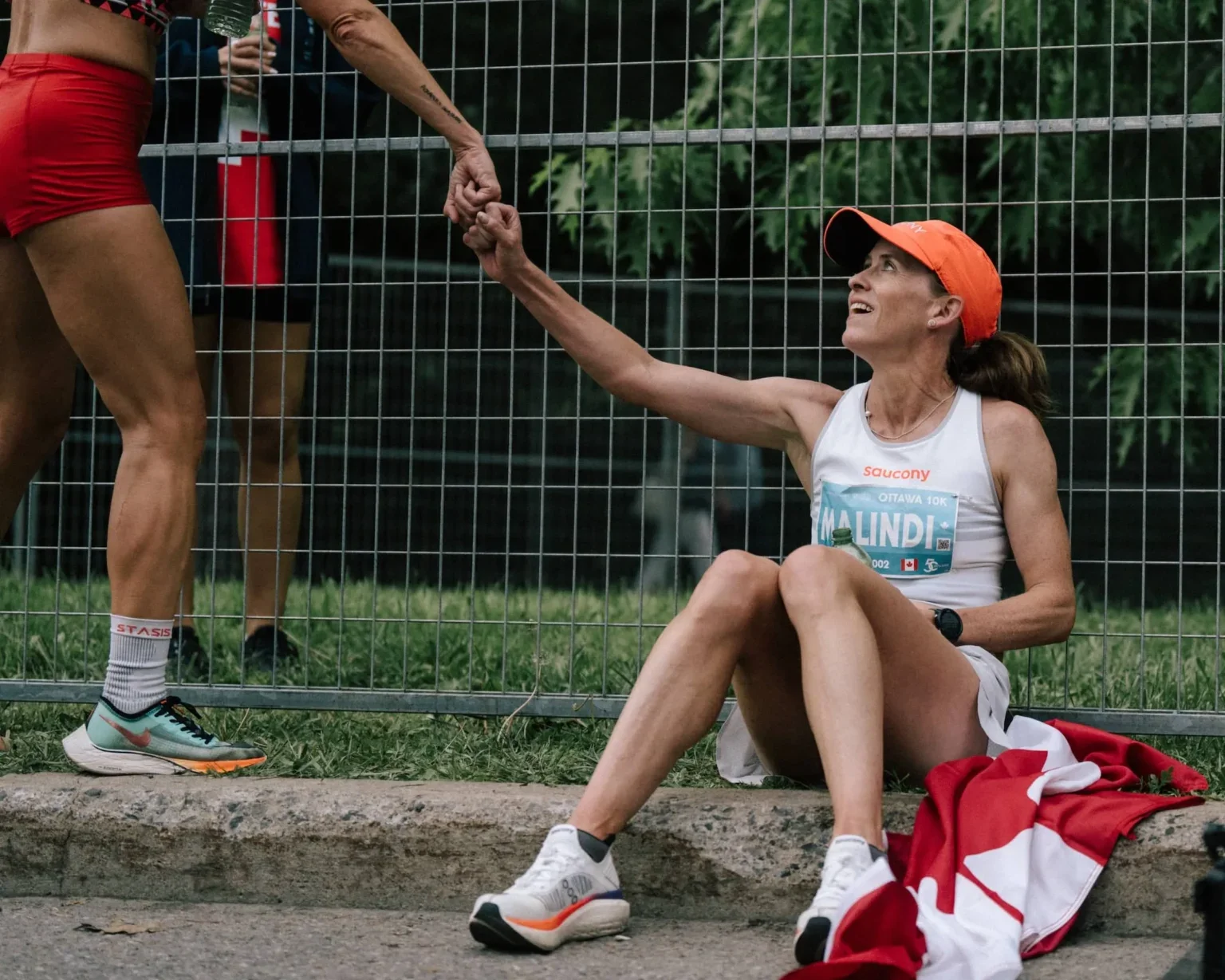
It’s been a bit rocky since then. I was so excited with how it went that I decided to jump back into a marathon in March in Tokyo and not take a lot of rest, and I think that was a mistake in hindsight, because I didn’t have enough recovery. By April I had a lot of quad pain, which turned out to be a bone stress injury in my femur.
I’ve begun running again, but it still hurts a little bit. I’m running about half an hour a day, way slower than usual, and I’m nowhere close to where I was. It’s going to take a lot of patience and a lot of work to get back to feeling good and confident in my running.
Has getting older changed how you approach training and recovery?
As you get older, you need to respect those pieces, like needing more recovery between races, especially marathons, and between sessions. I sometimes feel kind of invincible, because I feel so good and things are going so well, but that doesn’t mean I can ignore the principles that are known to be important in training.
I wouldn’t say it’s dictated by age. That doesn’t bother me. But a factor of age may be having more injuries that take longer to get over. I’m not saying that because I’m 46 I won’t continue doing this, but because I’m 46 I have this injury. I also had injuries when I was 20, so it’s not like you don’t get injured when you’re younger.
Will I get back to the same level as before? I don’t know at the moment.
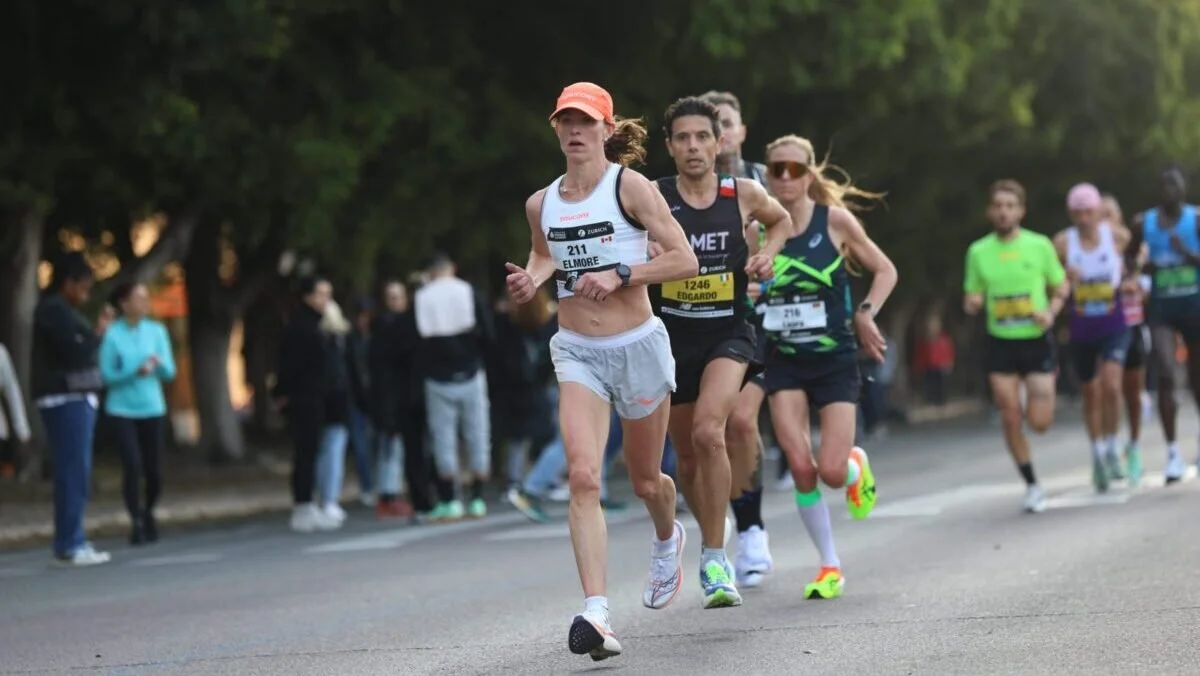
Malindi running 2:24 in Valencia. Photo: Bjorn Paree / Canadian Running
What does the road ahead look like?
Right now I’m not exactly sure where things are going to go. I would love to get back to the level I was running at last year. A year ago I thought, if I could be running like this a year from now, I’d qualify for the 2028 Olympics, and I would love to go.
But at the moment it’s more about feeling like myself again and taking it one step at a time. It’s a sport you can do forever, really, at different levels. Whether I continue at the highest level and go through the rigorous qualification period is still a bit TBD.
Saucony extended your contract when you were 44. What has your experience with sponsorship been like?
I’m really fortunate that Saucony is a value-based company, and I think they see value in my story and what I’ve been able to do in the sport. They took a 44-year-old athlete and wrote a two-year extension for me, up to age 46. That’s pretty amazing. Companies are saying, we believe in you, we support you, we see value in what you’re doing, and that gave me a lot of confidence.
I think they also recognize that so many women in their forties are into running and are trying to manage kids, or families, and busy working lives, and still find time to run. Being in the marathon is really an advantage for me, because so many people are doing it. You don’t have to be in a niche sport. There aren’t many 45-year-old pole vaulters. With the marathon, people can buy a pair of shoes, sign up for a race, and do it on their own terms. So I’m kind of in the right event, and maybe my story is more relatable than somebody who’s fresh out of college and doesn’t have all these things to consider.
I’m really fortunate that Saucony is a value-based company, and I think they see value in my story and what I’ve been able to do in the sport. They took a 44-year-old athlete and wrote a two-year extension for me, up to age 46. That’s pretty amazing.
Malindi Elmore
What Needs to Change
Is there anything you’d want people to know about sport and motherhood that isn’t talked about as much?
When I stepped away from the track in 2012 because I wanted to have a family, I really felt it was a choice between the two. You could either be an athlete or have a family, and you couldn’t do them at the same time.
I’m really happy to see that narrative has changed a lot, even in the 12 years since I had my son. I didn’t really have examples when he was born of people returning to the sport at a high level and continuing to do it.
Now there are so many more examples of success coming back to the sport, and I’d like to see people not just come back for a year or two, but continue to build meaningful, long-term careers with children who can grow up in the sport like mine have. It’s going to be super fun to see the impact it has on these kids, and where they end up.
If you could change one thing about how sport supports athlete parents, what would it be?
I almost think that Team Canada needs a person dedicated to support and liaise with Olympians who have children. We’ve got biomechanists, nutritionists, sports psych, everything to help, but honestly, the biggest, most stressful piece in my whole thing is how are my kids going to be okay?
Why This Conversation Matters
Malindi’s story shows that athlete motherhood doesn’t end when the baby stage does. Being allowed through the door is not the same as being supported once you’re inside, and the gap between the two is where families end up paying, in money, in energy, and in missed opportunities. As more athletes build long careers alongside their kids, the support around them has to keep pace.
Acknowledgement: This interview is part of MOMentum’s partnership with Dr. Kerry McGannon at Laurentian University. Interview and writing by Jill Moffatt, OLY, MOMentum co-founder and Laurentian PhD student.
